 TalkCards
Written by the TalkCards team · Published 2026-08-16
Questions for Married Couples: Three Rounds, From Easy to Honest
Questions for married couples that go past “how was your day” — a three-round format that starts easy, gets more honest, and ends with the ones you have been avoiding.
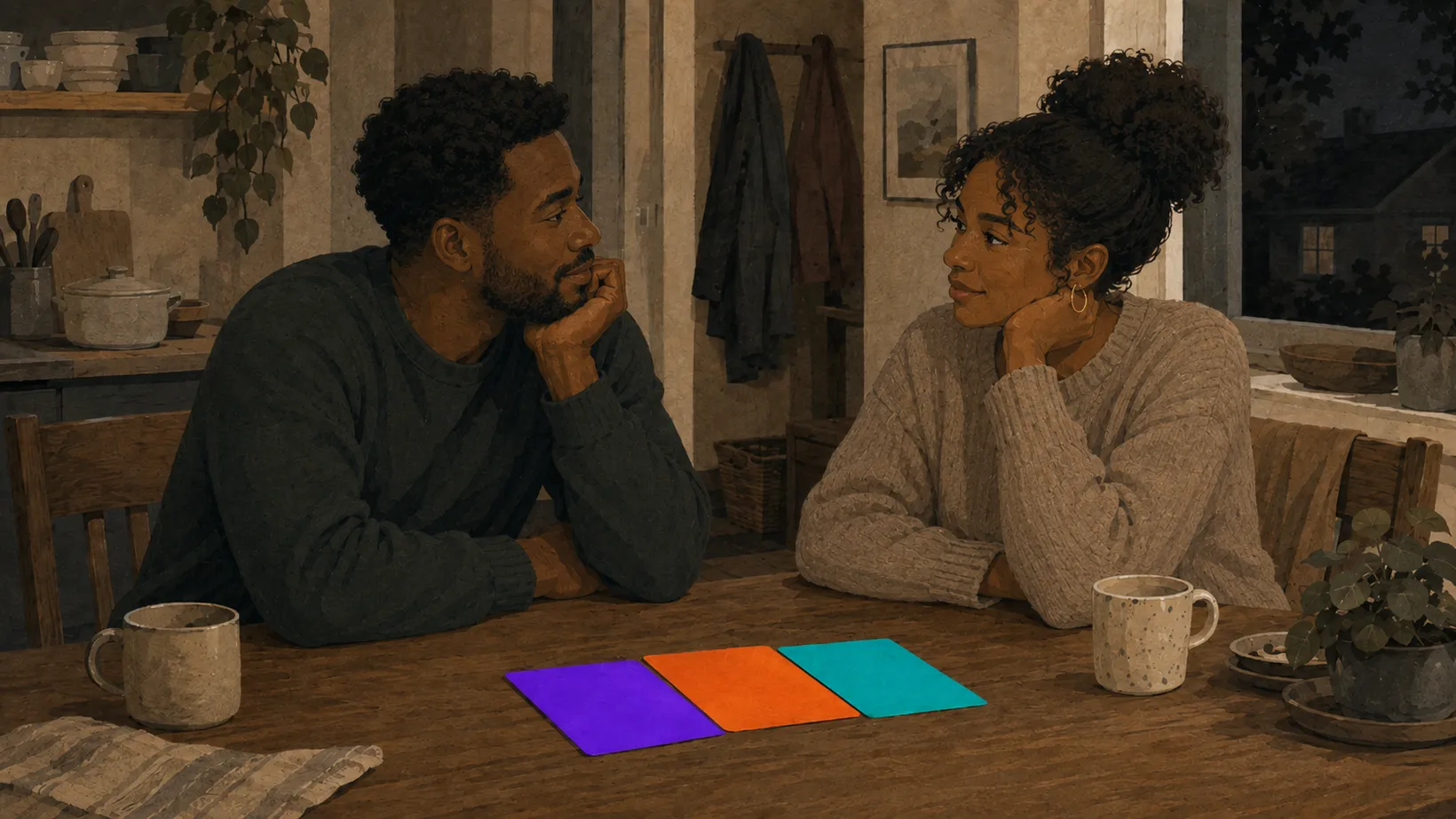
Nobody runs out of things to say in the first year.
You run out somewhere around year four, or seven, or eleven — not because you stopped caring, but because you already know the answers.
You know how their day went, roughly. You know what they think about their boss, their sister, the thing you argued about in March. The obvious material is used up.
So dinner becomes logistics. Who is picking up what. Whether the car needs an oil change. Then the plates go in the sink and the evening quietly ends.
The advice you usually get for this is “communicate more,” which is a bit like telling someone who is lost to “navigate better.”
What actually helps is smaller: having a question in front of you that neither of you would have thought to ask.
Below is a format that works well for couples who have been together a long time. Three rounds, deliberately in this order — because the third round does not work if you start there.
Why long-married couples run out of things to talk about
Early on, conversation is easy because everything is new information. You are still building a picture of each other, and almost any question returns something you did not know.
After enough years, that well runs dry. Not the relationship — the well.
This is the part people misread. Running out of things to say feels like evidence that something has gone wrong, so couples treat it as a relationship problem and get quietly worried about it.
Most of the time it is an inventory problem. You have simply asked each other all the questions that occur naturally, and nothing in daily life generates new ones.
Which is good news, because inventory problems are much easier to solve than relationship problems. You do not need to feel differently about each other. You need better questions.
Round one — the easy questions
Start light. This round exists to get you both talking before anything is at stake.
- What is something you have changed your mind about in the last few years?
- What did you think our life would look like by now?
- What is the best money we have ever spent together?
- Which version of me did you fall for — and is it the same one you live with?
- What is something small I do that you would miss?
These look mild, and they are. That is the point. A first question that demands vulnerability will get you a short answer and a change of subject. If you want a whole evening that stays in this register, the date night questions for couples are built for it.
Do not rush this round. If one of these opens up into a real conversation, stay in it. The list is not a checklist, and finishing it is not the goal.
Try round one tonight
The Getting Closer deck is exactly this kind of question — easy first, no setup, opens in your browser.
1,001 questions · One phone is enough
Round two — the ones that need a little more honesty
Once you are actually talking, the questions can ask for more.
- When do you feel most like yourself with me?
- What do you need from me that you have stopped asking for?
- Is there something you have been carrying alone lately?
- What part of our life together would you not want to change, ever?
- When did you last feel proud of us?
Notice that these are not accusations dressed up as questions. “What do you need that you have stopped asking for” invites an answer; “why don’t you ever help around the house” does not.
If your partner gives a short answer here, that is fine. Take it and move on. A short answer to a real question is still more than logistics.
Round three — the conversations you have been avoiding
Every long relationship has a small pile of subjects that never come up on purpose. Jealousy. Money. In-laws. The thing one of you said two years ago. What you each actually want the next ten years to look like.
Avoiding them is not a failure. It is usually sensible — these topics need energy and goodwill, and most evenings do not have a surplus of either.
But avoided conversations do not decay. They wait.
- Is there something we disagree about that we have quietly agreed not to discuss?
- What do you worry about that you have never said out loud to me?
- Where do you feel like you have compromised more than I have?
- What would you want to be different a year from now?
- Is there anything you are still holding against me?
Two rules for this round, and they matter more than the questions themselves. First: only do it on a night when you both have the energy — not at 11pm, not after a hard week, not to settle a score. Second: whoever asks goes first. If you would not answer it yourself, do not ask it.
You do not have to reach this round. Plenty of good evenings stop after round one. But if you never get here, those subjects stay in the pile. When you do want a night in this register, the Tough Talks deck — hard questions for couples — stays in it, one card at a time.
How to actually play it tonight
The format is deliberately unambitious:
- One question at a time, out loud, both of you answer it.
- Whoever asks answers first.
- Any question can be passed on, no explanation owed.
- Stop while it is still going well.
That last one is the rule people skip. The instinct is to keep going while the conversation is good, until it drifts into a hard subject nobody prepared for and the evening ends flat.
Ending early is what makes you both willing to do it again next week — and doing it again is the entire point. One long conversation changes very little. A habit of small ones changes a lot. If you would rather not run the list yourself, the Getting Closer deck deals this kind of question one card at a time.
For the simplest version, play the free question game for couples and pass one phone back and forth.
If a question lands somewhere hard
Sometimes round three does what it is designed to do and it stops being comfortable.
That is not the game going wrong. But it is worth knowing what to do next.
Do not try to resolve it that night. The conversation you have at the moment something surfaces is almost never the useful one — you are both reacting. Name it, agree to come back to it, and come back to it.
And if the same subject keeps surfacing and keeps going badly, that is a reasonable point to talk to someone who does this for a living. A deck of questions is good at opening a door. It is not a substitute for a couples therapist, and it does not pretend to be.
Start with the easy round
Pick a mood, draw one card, and let the evening go where it goes. You can save the harder rounds for a night you both have the energy.
1,001 questions · Nothing to download